
Just where you are

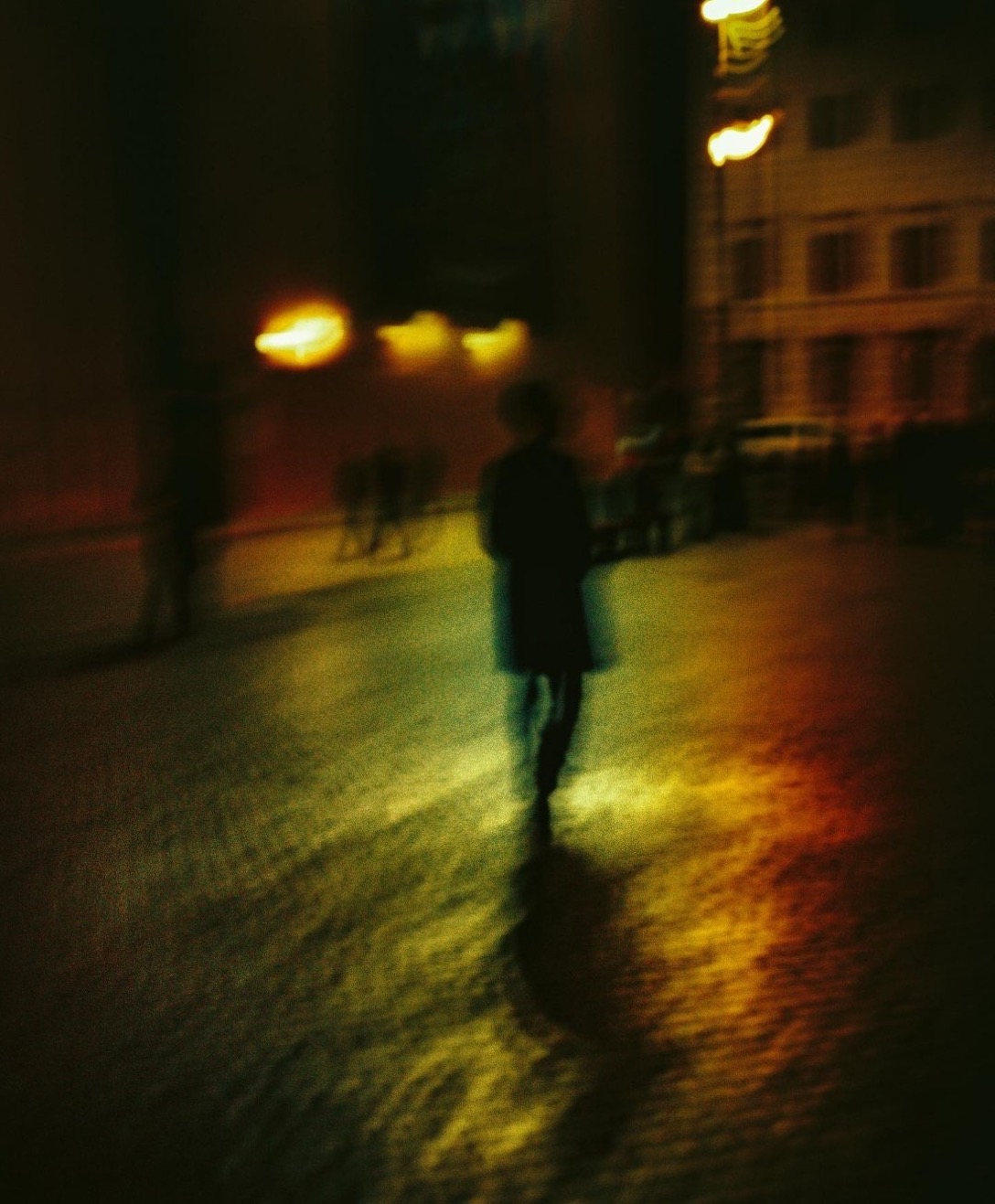
Man moves through city like a brief pause in a fast-moving film. Behind him, the orange glow of the streetlights hums quietly, almost like a pulse, while everything else around him feels rushed and sharp. Cars cut through the dark, their headlights opening and closing little strips of the future as they pass. For them, the road is something to conquer. For him, it is something to live inside.

That difference says a lot about the world we live in now. Everything seems to be speeding up, and the pressure is always the same: keep up, keep moving, don’t fall behind. Hartmut Rosa calls this social acceleration, and it feels exactly right. The trouble is not just that life is fast. It is that speed has become a kind of moral demand. To be slow starts to feel like failure. To be delayed starts to feel like being left out of existence itself.

But this man resists that logic by continuing at his own pace. He resists the city’s demand over his body. In that sense, it comes close to Lao Tzu’s idea of wu wei — not doing nothing, but acting without strain, without forcing oneself against the grain of things.

The streetlights stretch his shadow long, then short, then long again, his body keeps moving through that change without asking permission. The cars hurry towards wherever they are going, but he remains with the road beneath his feet, present to the moment instead of racing past it.

The man’s slow walk becomes its own kind of resistance. It says that the soul cannot be rushed, and that there is a strange, unsettling beauty in just being where you are.

Popular posts from this blog

Automatism

To paint the anatomy of terror is, an act of surrender. We are taught from the first tremor of ambition that art is a mountain to be scaled, a discipline of the iron will, a relentless sharpening of the blade. We believe that if we only try harder—if we refine the stroke, master the pigment, or sweat over the syntax—we might finally pin the ghost of our anxiety to the canvas. But the ghost only responds to silence. The fundamental challenge of the artist is the systematic dismantling of the self. To reach the jagged edges of fear and the suffocating depths of anxiety, one must achieve a state of radical porousness. It is a terrifying vulnerability, a deliberate thinning of the skin until the barrier between the internal abyss and the external world becomes a membrane of light. We must become vessels rather than architects. This is the essence of Automatism: the courage to let the hand move before the mind can censor it. When we sit before the void of a blank page or a white canvas, our...

Spatial Longing

  The stone of the third step is unremarkable, a slab of weathered granite that carries the indifferent history of the street. Every evening, as the light thins into a bruised violet, the dog arrives. He occupies the space, folding his limbs into the geometry of the threshold, and remains until the streetlamps hum with full current. Then, he leaves. This is an act of spatial longing—a tethering that requires no anchor. To observe this repetition is to witness a form of attachment that bypasses the traditional mechanics of ownership. In our human architecture, we struggle to conceive of belonging without the scaffolding of "mine" or "ours." We fence, we deed, and we domesticate. But the dog’s presence on the doorstep suggests a different topography of being. It is what Giorgio Agamben might describe as a state of exception rendered into a physical habit—a way of being "outside" that is nonetheless intimately folded into the "inside." The dog...

Clarity What?

  The siren song of "clarity" is perhaps the most sophisticated deception we perform upon ourselves. We treat it as a terminal station—a sun-drenched plateau where the jagged edges of existence finally align, and the static of the soul yields to a crisp, high-definition signal. We tell ourselves that once the fog lifts, once the "model" is perfected, we will finally possess the map to the labyrinth. But clarity is a flickering phosphorescence on the surface of an endlessly churning sea. It is the temporary, often desperate, engagement with a perceived understanding of a world that remains, at its core, indifferent to our need for symmetry. We craft mental models to maintain a functional sanity—to prevent the sheer, unadulterated chaos of being from collapsing our internal architecture. As George Box famously noted, all models are wrong, though some are useful. We navigate by these ghosts of logic, these obsolete frameworks of how things ought to be. We build a cathe...